The Difference Between a Question and a Decision
The difference between a question and a decision helps groups identify what they need to know, then choose a response that fits the issue.
“Should we move the team meeting?” is a decision disguised as a question. The difference between a question and a decision matters because a group can settle on a change without first understanding what is making the current arrangement difficult.
Imagine a fictional neighbourhood book group that meets in a café on Thursday evenings. Several members arrive late, and the organiser wonders whether the group should switch to Wednesday. Before comparing diaries and bus routes, the group needs to pin down what it is trying to understand.
Start with the uncertainty, not the proposed fix
A question seeks information, an explanation or a judgement. A decision chooses an action from the available options. “Why are people arriving late?” seeks an explanation; “Should we meet on Wednesday?” proposes a choice.
In the book group, lateness is an observation, not an explanation. Members might be delayed by work, a bus connection, the café’s crowded entrance or a forgotten start time. Moving the meeting could help with some causes and make others harder to manage.
The organiser can pause and ask, “What is making it difficult for members to arrive by the start time?” That wording allows for several explanations instead of assuming Thursday is the problem.
A decision-shaped question can narrow the discussion
“Should we…?” can be a sensible way to raise a choice, but it may direct attention to one remedy before the group knows enough. If members discuss only whether to move the meeting, they may overlook a later start or a clearer reminder.
The point is not to investigate every possible cause. It is to notice when a proposed action is being treated as the issue itself. Ask, “What would we need to know before choosing?”
For the book group, the missing information might be whether late arrivals relate to the day, the start time or the journey. Naming that uncertainty gives the conversation a purpose without turning it into a formal inquiry.
Keep the question and the choice visible
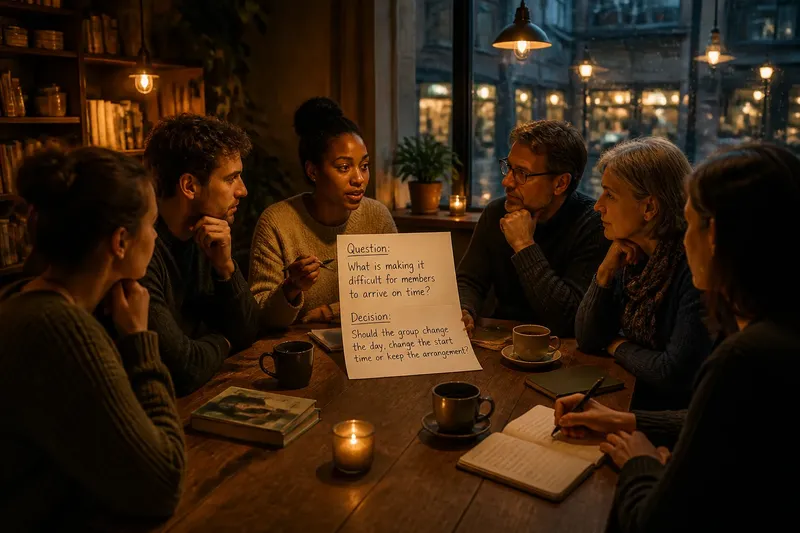
The organiser writes two lines on a sheet of paper:
- Question: What is making it difficult for members to arrive on time?
- Decision: Should the group change the day, change the start time or keep the arrangement?
This separation lets members share information without treating each comment as a vote. One person says the bus connection is awkward on Thursday; another says work often runs late on both days. Someone else notes that the reminder arrives on the morning of the meeting, when plans may already be settled.
Each comment could matter, but none answers the whole question by itself. The group can ask whether a pattern is emerging, what remains unclear and which response addresses the difficulty members have described.
Use the answer to shape a considered choice
Say the fictional book group identifies the current start time after work as its main difficulty. The organiser writes down the options: keep the same time, start later or change the day. The members agree to try a later start while keeping Thursday and the café. The expected observable result is whether members find it easier to arrive before the meeting begins.
That choice does not establish that a later start is best for everyone. It follows from the group’s current understanding and can be reconsidered if the experience does not fit that explanation. If the discussion instead points to a difficult bus connection or an easily missed reminder, a different response may make more sense.
Before acting, the organiser can state the reasoning plainly: “We think the current start time is difficult after work, so we’ll try a later one and notice whether arrivals become easier.” The sentence connects the choice to the question it is meant to address.
Questions about questions and decisions?
How can I tell whether a sentence is a question or a decision?
Ask whether it seeks an answer or selects what to do. “What is causing the delay?” seeks an explanation, while “Should we leave earlier?” raises a possible response.
Can one conversation include both?
Yes. Make the question clear, then use what the group learns to consider a decision. If a proposed action reveals that an important detail is unclear, return to the question.
What if we must decide before we know the full answer?
State what remains uncertain and what the choice is based on. A group can make a provisional decision while recognising that new information may give it reason to reconsider.
Does separating the question from the decision slow things down?
It may add a brief pause, but that can prevent a longer debate about remedies that miss the concern. Keep the pause practical: identify what the action is meant to solve.
Check that the choice responds to the real issue
When a conversation circles around several possible actions, return to the question the group is trying to answer. For the book group, keep “What makes arrival difficult?” separate from “Which meeting arrangement should we choose?”
The difference between a question and a decision is useful in households, clubs and teams: it helps people avoid mistaking their first proposed remedy for the problem. Before settling on an action, state the uncertainty in one plain sentence and check that the choice responds to it.